
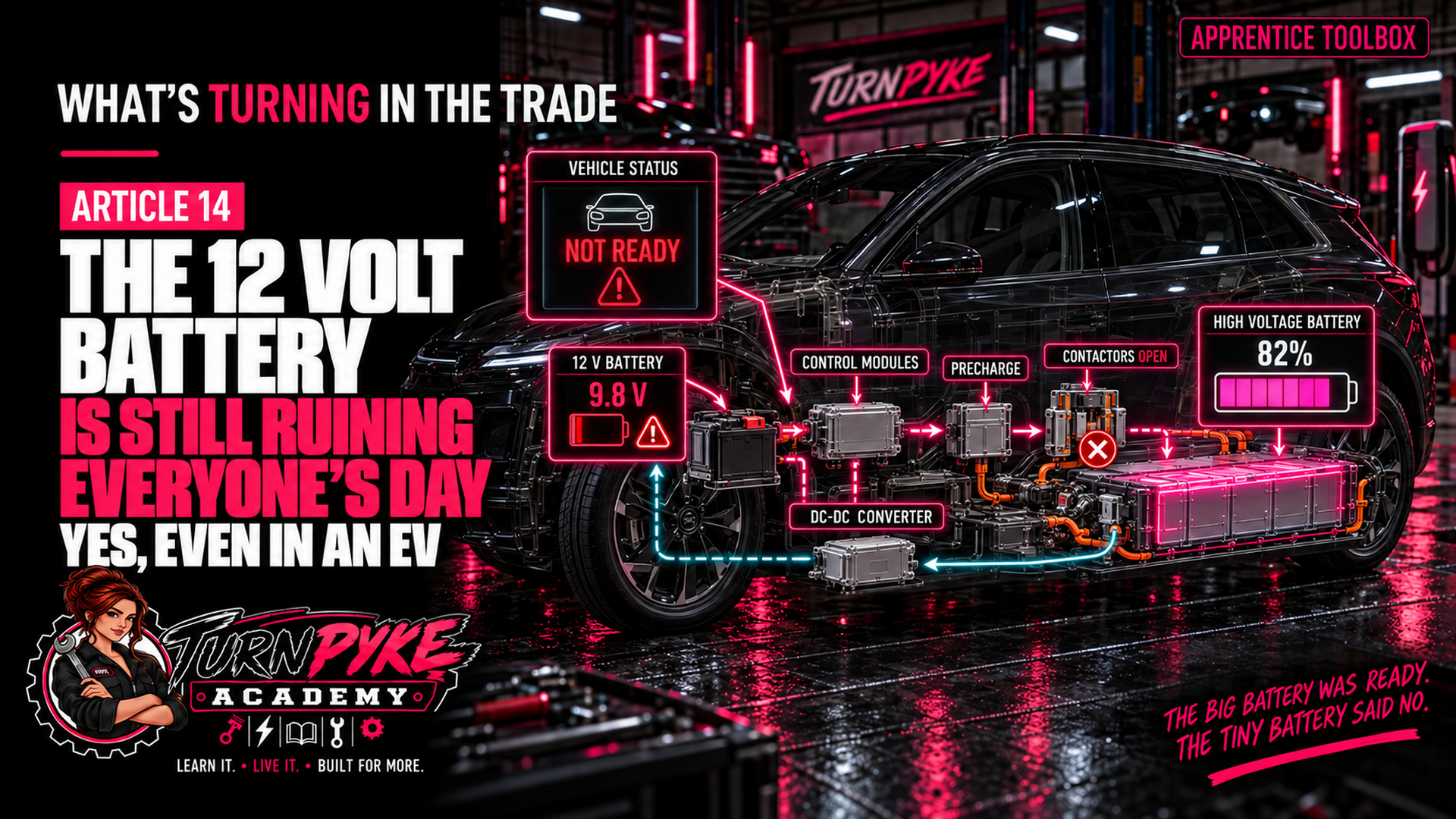
An electric vehicle contains a massive high voltage battery capable of storing enough energy to propel several thousand pounds of vehicle down the highway.
Hundreds of volts.
Electric drive motors.
Power electronics.
Sophisticated battery management.
Regenerative braking.
Thermal management.
Software controlled everything.
A rolling monument to modern engineering.
And what prevents the whole futuristic masterpiece from waking up one Tuesday morning?
Sometimes the same sad little 12 volt battery that has been ruining mornings since your grandmother had a licence.
Outstanding.
You can have 80 percent charge showing in a high voltage battery worth more than my car and the vehicle can still sit there looking at you like: “No.”
Because before the big battery gets involved, the vehicle's low voltage electrical system has some very important work to do.
Welcome to the part of EV diagnosis nobody puts in the glamorous advertisements.
1. What happened?
When electric vehicles started becoming common, it was reasonable to assume the traditional 12 volt battery might disappear.
After all: THERE IS ALREADY A GIANT BATTERY IN THE CAR.
Why do we need a tiny one too?
Because the high voltage battery and low voltage electrical system have very different jobs.
An EV still has familiar low voltage equipment: modules, lighting, locks, displays, wipers, communication networks, control electronics, relays and other equipment depending on vehicle design.
But there's another job that matters enormously.
The low voltage system helps wake the vehicle up.
The high voltage battery is not simply permanently connected to every high voltage component waiting enthusiastically for someone to touch something.
Main high voltage connections are controlled by large electrical switches called contactors.
Those contactors need to be controlled.
Modules need to wake up.
Safety checks need to happen.
Communication needs to happen.
The vehicle needs to decide: “Yes. Conditions are acceptable. We may now unleash the spicy electricity.”
And a functioning low voltage system is part of making that happen.
So: high voltage battery charged? Excellent.
12 volt system dead?
Congratulations.
You may own an extremely expensive driveway ornament.
2. How does it work?
Let's separate the two electrical worlds.
High voltage side
Depending on the vehicle, the high voltage battery may supply systems such as the drive motor, inverter, high voltage compressor, battery heater, cabin heater, DC fast charging system and other high voltage components.
This is the serious orange cable neighbourhood.
We respect the orange cable neighbourhood.
Low voltage side
The low voltage system powers many of the electronics required to control the vehicle.
Think of it like this:
High voltage battery = muscle.
12 volt system = the person yelling instructions at the muscle.
Having enormous muscles is not particularly useful if nobody woke up to tell them what to do.
What happens when you try to make the EV READY?
When the driver requests the vehicle to become READY, the control system begins checking whether conditions are appropriate to connect the high voltage battery to the rest of the high voltage system.
That can involve communication between multiple controllers.
The battery management system monitors battery conditions.
Safety circuits are checked.
The high voltage interlock may be monitored.
Precharge may occur.
And eventually the main battery contactors can close.
Exact architecture varies between manufacturers.
But here's the apprentice friendly version:
The big battery does not just kick the door down and yell “LET'S FUCKING GO.”
There is a process.
What are contactors?
Contactors are essentially very large electrically controlled switches.
They allow the vehicle to connect or disconnect the high voltage battery from the vehicle's main high voltage bus.
Why would we want that?
Safety.
When conditions are correct and the vehicle wants high voltage available, the contactors close.
And what operates the control electronics and contactor coils?
Low voltage electricity.
Do you see where this is going?
The 12 volt battery is dead
You walk up to the EV.
Traction battery: 73 percent.
Fantastic.
You press the start button.
Nothing useful happens.
One possibility is that the low voltage system cannot properly wake the control modules and energize the equipment needed to bring the high voltage system online.
The enormous traction battery may be sitting there full of energy.
But if the system controlling access to it cannot operate, that energy remains unavailable.
This is like having $50,000 in your bank account while your debit card has expired and the bank is closed.
Technically wealthy.
Functionally buying nothing.
What is precharge?
High voltage components such as inverters contain capacitors.
When you initially connect a battery to a large discharged capacitor, the capacitor may try to draw a very large amount of current very quickly.
We generally describe that as inrush current.
Which is electrical engineering language for: “Everyone calm the fuck down.”
The precharge circuit allows high voltage bus capacitors to charge more gradually before the main contactors fully connect the battery.
So the startup process can conceptually look like:
Low voltage system wakes controllers
Safety conditions checked
Precharge begins
High voltage bus rises appropriately
Main contactors close
Vehicle becomes READY
There is more detail depending on the system.
But that's enough to understand the diagnostic story.
Where does the 12 volt battery get charged?
There is no conventional engine driven alternator.
Instead, EVs commonly use a DC to DC converter.
This takes power from the high voltage battery and converts it to the lower voltage needed by the low voltage electrical system.
Essentially: DC to DC converter = EV alternator's weird electronic cousin.
Not technically an alternator.
Same general job in the conversation: keep the low voltage system supported.
So what happens if the DC to DC converter has a problem?
Imagine the 12 volt battery keeps going dead.
Maybe the battery itself is weak.
Maybe a parasitic draw exists.
Maybe there is a connection problem, ground problem, charging strategy problem, software issue or control fault.
Maybe the DC to DC converter is not supporting the low voltage system correctly.
So the complaint “12 volt battery keeps dying” does not automatically mean “replace 12 volt battery.”
I can hear the parts cannon loading.
Put it down.
But why not just permanently power everything from the high voltage battery?
Because keeping several hundred volts connected everywhere all the time would create some obvious safety and control concerns.
The low voltage system allows many controllers and safety systems to operate while the main high voltage contactors remain open.
Then the vehicle can determine whether conditions are safe before high voltage is connected.
That's a good arrangement.
It just has the hilarious side effect of allowing a massive EV to be defeated by a battery approximately the size of something you'd expect to power a lawn tractor.
Engineering keeps us humble.
3. Why should technicians care?
Because a dead EV does not automatically mean HIGH VOLTAGE BATTERY FAILURE.
Please.
Do not begin there.
A no READY condition can potentially involve low voltage battery condition, low voltage connections, fuses, grounds, contactor control, precharge, interlock faults, communication faults, module wake up, high voltage battery conditions, immobilizer functions, software and manufacturer specific safety logic.
So when the futuristic car refuses to wake up: start with fundamentals.
What is low voltage system voltage?
Does it remain stable under load?
Are the modules awake?
Can you communicate?
What DTCs are stored?
Is the DC to DC converter operating when expected?
What does the service information say?
Suddenly the giant intimidating EV becomes an electrical diagnostic problem.
We know how to do electrical diagnostic problems.
Low voltage can create MANY codes
Poor voltage does not always create one nice DTC saying: “Hi Emily. The 12 volt battery is weak. Please replace after testing. Have a lovely afternoon.”
No.
Instead you might get communication faults, module voltage faults, ADAS warnings, brake warnings, steering warnings, battery management faults and random systems refusing to initialize.
And suddenly the scan report looks like the vehicle has developed seventeen separate personality disorders.
Maybe.
Or: one problem. Twelve witnesses.
OUR OLD FRIEND.
Before diagnosing every module independently, check system voltage.
Low voltage makes computers weird.
Automotive computers are very advanced.
They are also occasionally as emotionally stable as a toddler who missed lunch.
A battery can show voltage and still be bad
You measure 12.4 volts and announce: “Battery is good.”
No.
Voltage alone does not prove battery condition.
A weak battery may show a reasonable open circuit voltage and still collapse when a load is applied.
Remember Article #4?
TEST UNDER LOAD.
Can the battery maintain appropriate voltage while actually doing work?
Static numbers are useful.
Operating behaviour is better.
We have spent fourteen articles slowly becoming suspicious of unloaded tests.
I approve.
Voltage drop is back too
Let's say the 12 volt battery itself is healthy.
But there is excessive resistance at a battery terminal, ground strap, power distribution connection, fuse connection or main low voltage cable.
Now the system may receive inadequate voltage while trying to wake up.
Does this sound familiar?
It should.
Article #4 has returned with a folding chair.
Voltage drop.
Fancy EV.
Same crusty ground connection.
Beautiful.
Parasitic draws still exist
Yes.
Even in an EV.
Modules can remain awake when they should sleep.
Connected services may operate.
Telematics may communicate.
Faults can prevent proper shutdown.
Accessories can draw power.
And depending on the vehicle, various systems may periodically wake.
So parasitic draw diagnosis can become more complicated than “everything off, meter says current.”
You may need to understand vehicle sleep strategy, wake up events, network activity, connected systems and manufacturer timing.
Again: READ THE SERVICE INFORMATION.
There it is.
Did you miss it?
I didn't.
And EVs can sometimes recharge the 12 volt battery while parked
Some EVs can use high voltage battery energy to maintain the low voltage battery automatically.
So when diagnosing a low voltage complaint, the vehicle may not behave exactly like a conventional car sitting with the ignition off.
Systems may wake.
Converters may operate.
Voltage may change.
Know the strategy before interpreting the measurement.
Otherwise you're standing there staring at the meter saying “WHY DID VOLTAGE JUST GO UP?” while the car quietly does exactly what it was programmed to do.
The vehicle isn't haunted.
Probably.
High voltage safety still matters
This article is about the low voltage system.
That does not mean we forget that an EV contains high voltage.
Low voltage circuits can command high voltage contactors and control systems that ultimately connect the traction battery.
Do not randomly disconnect things to “reset the car.”
There is a procedure.
Follow it.
High voltage systems do not appreciate improvisational theatre.
4. What should an apprentice remember?
An EV still needs a healthy low voltage electrical system to wake up and control the high voltage system.
The high voltage battery stores propulsion energy.
But the low voltage system powers many of the modules and control functions required to wake the vehicle, run electronics, perform safety checks, control contactors, establish communication and prepare the high voltage system for operation.
So: high voltage battery charged does NOT automatically mean vehicle can become READY.
That is the trap.
Remember the DC to DC converter
No alternator.
Instead, high voltage DC gets converted into low voltage DC.
If the auxiliary battery repeatedly discharges, think beyond the battery itself.
Is it being charged correctly?
Does a parasitic draw exist?
Is the converter operating?
Are connections good?
Does the vehicle sleep properly?
Diagnose.
And remember this beautiful absurdity
The EV may contain a 400 volt battery, an 800 volt architecture, multiple electric motors, high speed communication networks, advanced driver assistance, remote software updates, battery preconditioning, regenerative braking, possibly steer by wire and possibly brake by wire.
And yet: a shitty little low voltage ground can still ruin the entire day.
THIS TRADE WILL NEVER RUN OUT OF MATERIAL.
5. The C of Q Connection
This article may be about EVs, but the diagnostic fundamentals are extremely familiar.
Understand battery state of charge, battery condition, voltage, current, resistance, voltage drop, series and parallel circuits, grounds, relays and contactors, DC to DC conversion, module power supply, network communication, parasitic draw, high voltage safety and diagnostic strategy.
The vehicle may be new.
Ohm's law remains stubbornly employed.
Example
A battery electric vehicle has a fully charged high voltage battery but will not enter READY mode. Multiple modules have stored low voltage and communication DTCs.
What should the technician check FIRST?
A. Replace the high voltage traction battery
B. Test the low voltage battery and power supply condition
C. Replace the drive motor inverter
D. Perform an alignment calibration
Correct answer: B. Test the low voltage battery and power supply condition.
Why?
Because the vehicle has multiple low voltage and communication faults, while the traction battery is known to be charged.
A low voltage supply problem can affect module wake up, communication and system initialization.
A jumps immediately to the most expensive thing in the vehicle.
That thing costs more than my car.
We will be testing some other things first.
C condemns the inverter without evidence.
Parts cannon rejected.
D is ADAS trying to wander into the wrong classroom.
Go away.
Another example
The 12 volt battery repeatedly becomes discharged, but testing confirms that the battery itself is healthy.
What should the technician investigate?
Think: Is the battery being supported correctly?
DC to DC converter.
Charging control.
Connections.
Parasitic draw.
Sleep strategy.
Do not keep replacing batteries and wondering why Battery Number Four has somehow developed the exact same personality.
At some point: the batteries are not the problem, Greg.
6. Sources
Hyundai 2026 Electric Vehicle Characteristics
https://ownersmanual.hyundai.com/full_webhelp/NE1N/2026/en_US/idd5f33d25f0b.html
Kia: EV Charging System Warning Information
https://ownersmanual.kia.com/full_webhelp/CV1/2024/en_CA/topics/chapter5_16_1.html
Tesla Service Information: Battery Safety Monitor and Contactors
Tesla Service Information: Precharge and Low Voltage Power
https://service.tesla.com/docs/Public/Roadster/Original/1.2.5/battery/descriptionandoperation.html
Tesla Service Information: Low Voltage and High Voltage Disablement
OEM SERVICE INFORMATION WINS.
Different EVs can use different low voltage battery chemistry, different DC to DC converters, wake up strategies, contactor systems, precharge arrangements, automatic charging strategies and diagnostic procedures.
Learn the principle.
Then look up the vehicle.
Do not walk into an EV bay announcing: “All electric cars are basically the same.”
That is how you summon an eight hour diagnostic.
7. Next Step
DAILY TORQUE
A battery electric vehicle has 75 percent traction battery state of charge but will not enter READY mode. The instrument cluster flickers during the startup attempt and several modules store low system voltage DTCs.
Which action should the technician perform FIRST?
A. Replace the high voltage battery pack
B. Test the low voltage battery and its main power and ground connections
C. Replace the traction motor
D. Perform battery preconditioning
Correct Answer: B. Test the low voltage battery and its main power and ground connections.
Why?
Because the symptoms directly point toward unstable low voltage supply.
Flickering electronics.
Multiple low voltage codes.
Failure to initialize.
Those are enormous clues.
The high voltage battery may have plenty of stored energy, but the vehicle still relies on low voltage electronics to wake up and control access to that energy.
A immediately replaces the most expensive battery because apparently we have inherited money.
No.
C does not explain the low voltage module faults or flickering electronics.
D prepares the high voltage battery temperature for certain operating or charging conditions.
It does not cure a low voltage electrical system currently fighting for its life.
Apprentice Takeaway: Before blaming the biggest battery in the vehicle, make sure the smallest one can actually wake everybody up.
And if you've spent the last several articles thinking: “Okay, but EVs have these enormous sophisticated batteries. Surely at least the stupid 12 volt battery problem has finally gone away.”
No.
Absolutely the fuck not.
Automotive technology looked at dead batteries, poor grounds, voltage drop, parasitic draws and corroded connections and said: “Those are classics. Keep them.”
So now we have vehicles capable of driving themselves through parking lots, recovering energy while braking, heating their own battery before reaching a charger, receiving software over the air, communicating over high speed networks and managing several hundred volts of electrical energy.
All sitting silently in a parking space because the 12 volt battery has 9.6 volts and no interest in participating today.
Perfect.
No notes.
This is why the fundamentals matter.
Because sometimes the answer to the futuristic EV diagnostic nightmare is still: “The ground cable is crusty.”
Beautiful.
Knowledge. Confidence. Drive.